True Guide to Workers’ Comp AI.

Insights, tools, and resources for insurance leaders navigating the AI era

Workers’ comp insurance professionals reviewing AI data insights together.

The workers’ compensation industry is at a turning point. AI is changing how claims get processed, how fraud gets detected, how risk gets assessed, and how the most forward-thinking organizations communicate at scale. For the leaders navigating it all, having the right information makes all the difference.

True built this resource hub for workers’ comp professionals who want to lead that change with confidence. Browse our latest AI-focused articles, download the 2025 State of AI in Workers’ Comp report, and explore how Vera by True is putting AI communications to work for carriers and self-insured organizations today.

New resources are added as the conversation evolves. Start here for the latest.

Workers’ Comp Insurtech AI Insights

Stay Current on AI’s Impact in Workers’ Comp

Our blog covers the evolving world of AI through the lens of workers’ compensation. Each post is written for the insurance leaders doing the hard work of staying ahead.

Pop-art hands take notes on paper, illustrating True's AIS 2026 workers' comp recap from NCCI's Orlando symposium.

Twelve Years In, the Story Just Got More Honest: Five Threads to Pull from AIS 2026

Ryan Smith just got back from NCCI’s Annual Issues Symposium in Orlando. The twelfth straight year of underwriting profitability for workers’ compensation held. The rooms in Orlando sounded different about it. True’s Amy Sliger walks through five threads from AIS 2026 worth pulling on as carriers head into 2026.
Human hand and robotic hand meeting in a handshake, illustrating human-AI collaboration in workers' compensation ahead of Mollick's AIS 2026 keynote.

What Mollick’s AIS Keynote on Artificial Intelligence (AI) Means for Workers’ Comp

Ethan Mollick takes the AIS 2026 keynote stage with a cross-industry frame on AI adoption. Workers’ compensation needs the localization. We unpack the honest state of AI adoption in our industry, where it is already paying off, where the gaps still are, and what ’embracing the AI revolution’ looks like for carriers, SIGs, captives, MGAs, and TPAs.
Hand holding a stethoscope, with the chestpiece revealing workers' compensation medical cost drivers (pill, scalpel, physical therapy band, price tag, and trend arrows) over percent and dollar signs. Hero image for the True Insurtech Solutions NCCI AIS 2026 medical severity blog.

Medical Severity Isn’t One Number: What’s Really Driving Claim Costs Heading Into AIS 2026

When someone says medical severity is up six percent, it sounds like a single data point. NCCI’s Raji Chadarevian frames AIS 2026’s severity session this way: medical severity is more than a single metric. Here’s what’s driving claim costs going into the rest of the decade.
Illustration of a claims professional reviewing paper documents at a desk beside a glowing computer screen, while tangled cords and disconnected cables pile up nearby, representing fragmented systems and the gap between AI investment and operational impact.

Workers’ Comp AI Investment: Why Aren’t You Seeing the Return?

Seventy percent of workers’ compensation carriers that have invested in AI have not achieved the outcomes they were looking for. That’s not a technology problem. It’s an implementation one. The difference between the organizations getting real returns and those still waiting usually comes down to three things: their data foundation, their workflow design, and whether their people adopted the tools.
`Illustration of a suited figure walking away from the viewer through a narrow corridor of towering document-covered walls, representing the complexity of AI compliance navigation in workers' compensation insurance.

Navigating the Regulatory Maze: AI Compliance in Workers’ Comp

If you’re implementing AI in workers’ compensation and not thinking about regulation, you’re already behind. State AI insurance laws are hardening fast. Here’s what compliance looks like in 2026 and how to build a defensible governance framework.
A crystalline AI hand passes an origami heart folded from blueprint paper to an open human hand, symbolizing human-AI partnership and workforce support in workers' compensation operations.

Your People Aren’t the Problem. Here’s How to Make Them Your Biggest AI Advantage.

AI isn’t coming to replace your workers’ comp operations team, but it is going to change what every role on that team looks like, and the organizations that manage that transition well will outperform those that don’t. This is a practical guide to evolving roles, building the skills that matter, and creating the culture that makes human-AI partnership work in workers’ comp.
Illustrated workplace panorama showing a warehouse, medical clinic, and office environment connected by flowing data lines, representing the convergence of technology across the workers' compensation industry.

10 Workers’ Compensation Technology Trends Every Executive Should Watch in 2026

Workers’ compensation is changing faster than most executives realize, and the insurers that thrive in 2026 will be the ones investing in technology to work smarter, move faster, and deliver better outcomes for injured workers. From generative AI and predictive analytics to cloud-native platforms and behavioral health integration, here are the ten technology trends every workers’ comp executive should understand right now.
Illustration of many uniform blue dots with one marked by a pink X, symbolizing how AI identifies an anomalous workers’ comp claim within a large dataset.

The New AI Blueprint for Fighting Workers’ Comp Fraud

Workers’ compensation fraud continues to evolve, and so do the tools used to stop it. This blog breaks down how AI-driven fraud detection is helping insurers uncover hidden patterns, accelerate investigations, reduce false positives, and strengthen overall outcomes through smarter, more precise detection.
Download the 2025 State of AI in Workers’ Compensation report to explore key trends, real-world use cases, and what insurance leaders should prioritize next.

Smarter AI Investments in Workers’ Comp: A Leadership Guide to True ROI

AI in workers’ comp isn’t about hype, it’s about value. This guide breaks down real-world ROI timelines, total cost of ownership, and how True’s integrated solutions help leaders invest smarter.
Digital illustration of AI-enhanced workers’ comp intelligence visualizing claims, risk, fraud, and safety data—supporting 2025 trends in automation, analytics, and underwriting precision.

AI in Workers’ Compensation: Key Insights from 2025 and What Comes Next

Artificial intelligence is already reshaping workers’ compensation—from claims and fraud detection to safety and underwriting. This blog breaks down the most impactful trends from 2025 and reveals where insurance leaders should focus next to gain strategic advantage in 2026.
Top 10 Workers' Compensation Insurance Technology Trends to Watch in 2025

Top 10 Workers’ Compensation Tech Trends to Watch in 2025

Now that 2025 is here, the workers’ compensation industry prepares for significant technological advancements. Key trends include the use of generative AI for claims, predictive cyber risk models, quantum computing for risk forecasting, and IoT devices for ergonomic monitoring. These innovations aim to enhance workplace safety, improve claims processing, and streamline compliance across multiple states.
Glass crystal ball on a smooth pedestal with glowing light and sparks, symbolizing reflection on workers’ compensation technology trends from 2024.

Reflections on Workers’ Compensation Tech Trends in 2024: Predictions Versus Reality

Did the top tech trends for workers’ compensation in 2024 live up to expectations? From AI and blockchain to IoT and telemedicine, discover how the year’s predictions shaped the industry.
Read More on the True Blog

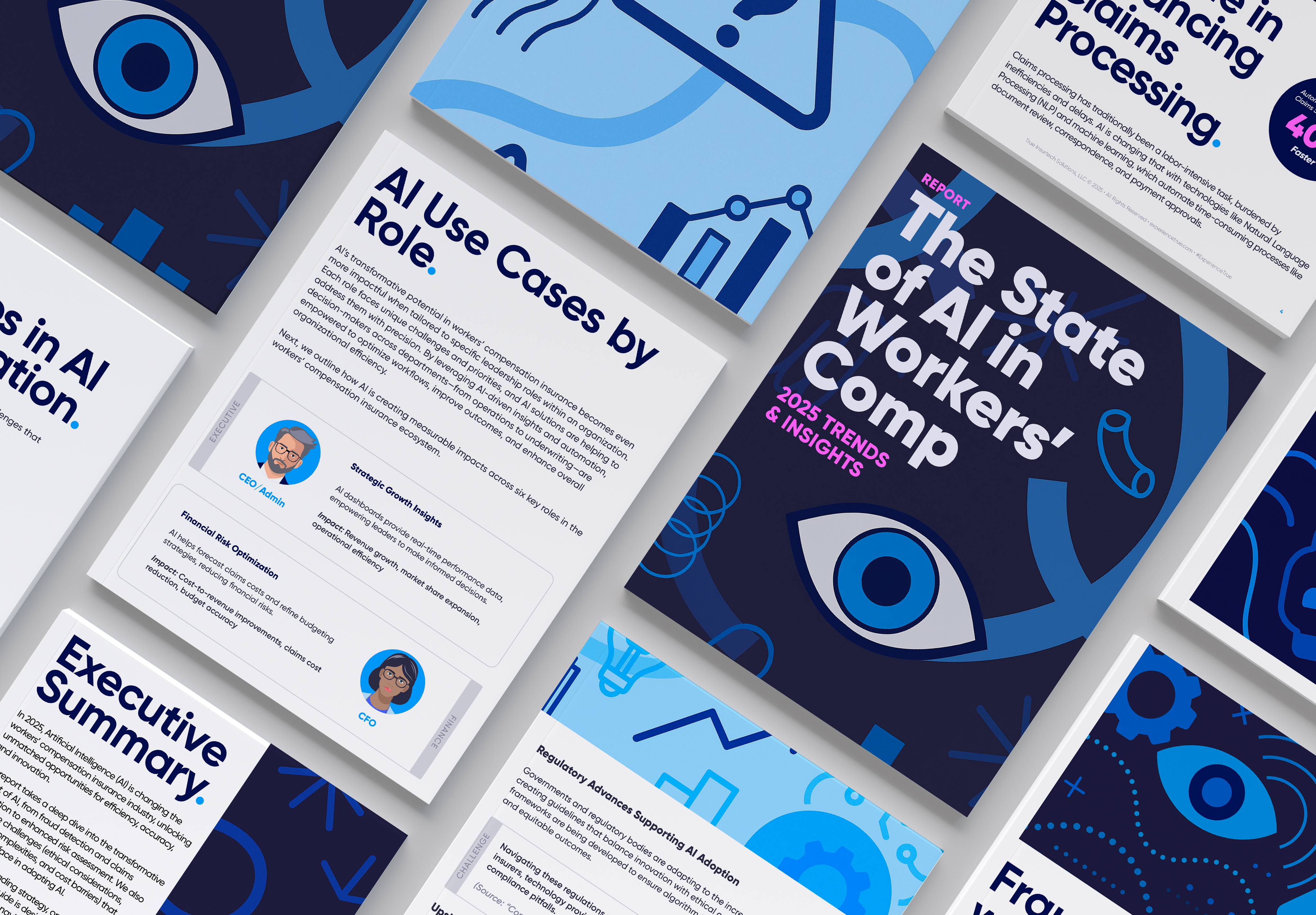
The State of AI in Workers’ Comp: Trends & Insights Report

Workers’ comp professionals are doing hard, important work every day. AI is here to make that work faster, smarter, and more sustainable.

True’s State of AI in Workers’ Comp report documents what’s happening in the industry right now. AI-powered fraud detection is improving identification rates by up to 60%. Machine learning tools are reducing claims administrative costs by up to 30%. Early adopters of AI-driven risk models are seeing loss ratio improvements of 15%. And companies implementing AI-driven safety programs are seeing workplace injuries decline by 25%.

The report covers six areas reshaping the industry: claims automation, fraud detection, risk assessment, IoT and wearable technology, AI implementation challenges, and the industry outlook. It also includes specific insights for six key leadership roles: CEO, CFO, CIO, CUO, CCO, and COO.

Whether you’re building a business case for AI investment or simply want a clearer picture of where workers’ comp is heading, this report gives you the data and context to move forward with confidence.

Bring Your Best Voice Forward with Vera by True

AI in workers’ comp reaches beyond claims processing and fraud detection. The quality of every conversation your organization has matters, too. With policyholders, brokers, claimants, and your own teams, clear and consistent communication is a competitive advantage.


Vera is the AI communications and experience engine built exclusively for workers’ compensation insurance. She helps carriers, MGAs, captives, and self-insured groups deliver messages that are clear, compliant, and consistent across every touchpoint. Vera generates outputs in your brand voice, runs pre-publication compliance checks, and keeps your team in control while handling the drafting work that slows them down.

Vera was born at True, which means she’s trained on the workers’ comp world. When your people spend less time drafting and more time advising, everyone wins.

Meet Vera

Have Questions?

Explore True and dig into powerful solutions for your insurance operations.